The domestic reverse charge (DRC) for VAT in the construction industry has been in effect since March 2021, yet many businesses still struggle with its implementation. This fundamental change to VAT accounting requires careful attention to ensure compliance — and getting it wrong can be costly.
Understanding the Reverse Charge
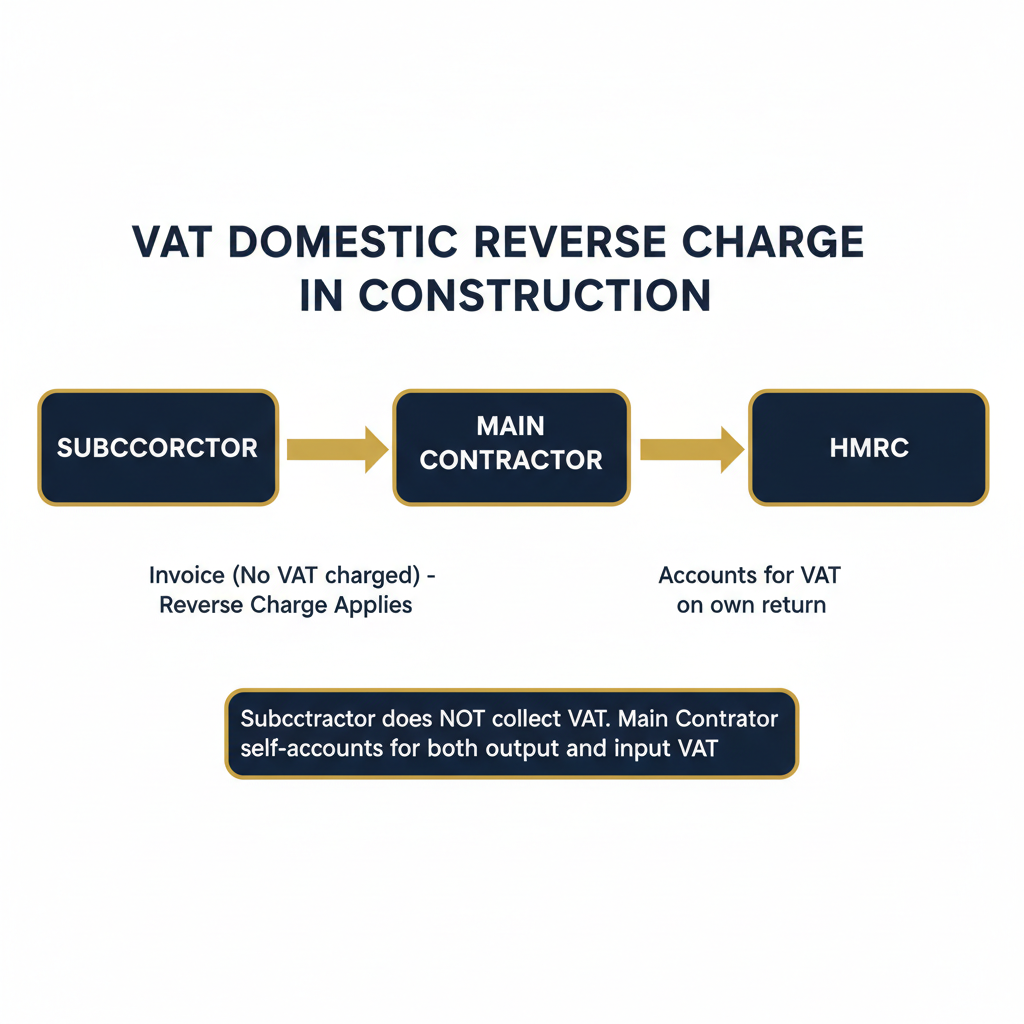
Under the reverse charge mechanism, VAT on qualifying construction services is accounted for by the recipient of the services, not the supplier. In practice, if you're a subcontractor providing in-scope services, you do not charge VAT on your invoice. Instead, the main contractor accounts for the VAT on their own VAT return — declaring it as both output tax and (subject to normal recovery rules) input tax simultaneously.
This mechanism only applies to standard-rated and reduced-rated supplies. Zero-rated supplies are not subject to the DRC.
The Three Key Conditions
Before applying the DRC, three conditions must all be met:
- CIS Construction Operations: The supply must fall within the scope of CIS construction operations as defined by HMRC. This is the primary gate. Services outside CIS — such as pure professional services like architecture, surveying, or project management when supplied on their own — are generally outside the DRC scope.
- Standard or reduced-rated: The supply must be standard-rated or reduced-rated for VAT purposes. Zero-rated supplies are excluded.
- Not to an end user: The customer must not be an end user. An end user is someone who receives the construction services for their own occupation or use and does not make an onward supply of those services. End users can notify their supplier of their status, and in that case normal VAT rules apply. There are also intermediary supplier rules to be aware of where connected businesses or landlord/tenant structures are involved.
Which Services Are Affected?
The DRC applies to CIS construction operations supplied B2B to VAT-registered customers who will make an onward supply of those services (i.e., not end users). This broadly covers building work, alterations, repairs, extensions, demolition, installation of systems (heating, lighting, power), and similar site operations.
Common exclusions include:
- Supplies to end users (who are not making an onward supply of the services)
- Pure professional services — architects, surveyors, and consultants supplying their professional services independently (as these fall outside CIS construction operations)
- Zero-rated construction work (e.g., construction of new dwellings)
- Supplies of staff or workers (as opposed to labour-only subcontracting)
A note on bundled supplies: Where professional services are supplied as part of a single mixed supply that also includes in-scope construction work, the position can be complex. HMRC guidance warns that if the principal element is subject to the reverse charge, the entire supply may follow that treatment. Take care with mixed contracts.
Labour-Only vs. Supply of Staff
One of the most common errors in practice is confusing labour-only subcontracting with the supply of staff. HMRC draws a clear distinction:
- Labour-only subcontracting (worker supplied to carry out construction operations under the contractor's direction, where the subcontractor is responsible for the work output) — typically within DRC scope if other conditions are met.
- Supply of staff / employment bureau services (workers supplied who remain under the client's direction and control, with no responsibility taken for the work itself) — generally outside DRC scope, as this is not a supply of construction services.
Getting this wrong is a frequent audit point. If in doubt, review the contractual terms and the degree of control over the workers.
Impact on Cash Flow
One of the most significant practical impacts is on subcontractor cash flow. Previously, subcontractors would collect VAT on their invoices, giving them use of those funds between invoice and payment to HMRC. Under DRC, subcontractors receive no VAT — this float disappears. Main contractors, meanwhile, account for output and input VAT simultaneously, making the position broadly neutral for them, subject to their normal recovery position.
If you're a subcontractor who has moved into a net VAT repayment position as a result of DRC, you should consider moving to monthly VAT returns to accelerate repayments from HMRC.
Compliance and Record Keeping
Proper compliance requires meticulous record keeping. You must maintain clear documentation showing which supplies are subject to the reverse charge and which are not. Invoices subject to DRC must reference the reverse charge — HMRC does not prescribe exact wording, but something like "Reverse charge: customer to account for VAT to HMRC" is widely used and accepted. The invoice should also clearly show the VAT rate that would apply, even though no VAT is charged.
We strongly recommend using accounting software configured correctly for the reverse charge to reduce the risk of errors on both sides of the transaction.
Common Mistakes to Avoid
- Applying DRC without checking the CIS construction operations condition first
- Applying DRC to supplies to end users who have not been identified and declared as such
- Applying DRC to zero-rated supplies
- Applying DRC to staff supply arrangements (rather than true labour-only subcontracting)
- Failing to include the required reverse charge wording on invoices
- Incorrect treatment of mixed supplies containing both in-scope and excluded elements
- Not switching to monthly VAT returns when in a persistent repayment position
Regular reviews of your VAT procedures — ideally with your accountant — can help identify and correct these issues before they become costly problems. If you're unsure whether DRC applies to a specific contract or invoice, it's always worth taking advice before submitting your return.